
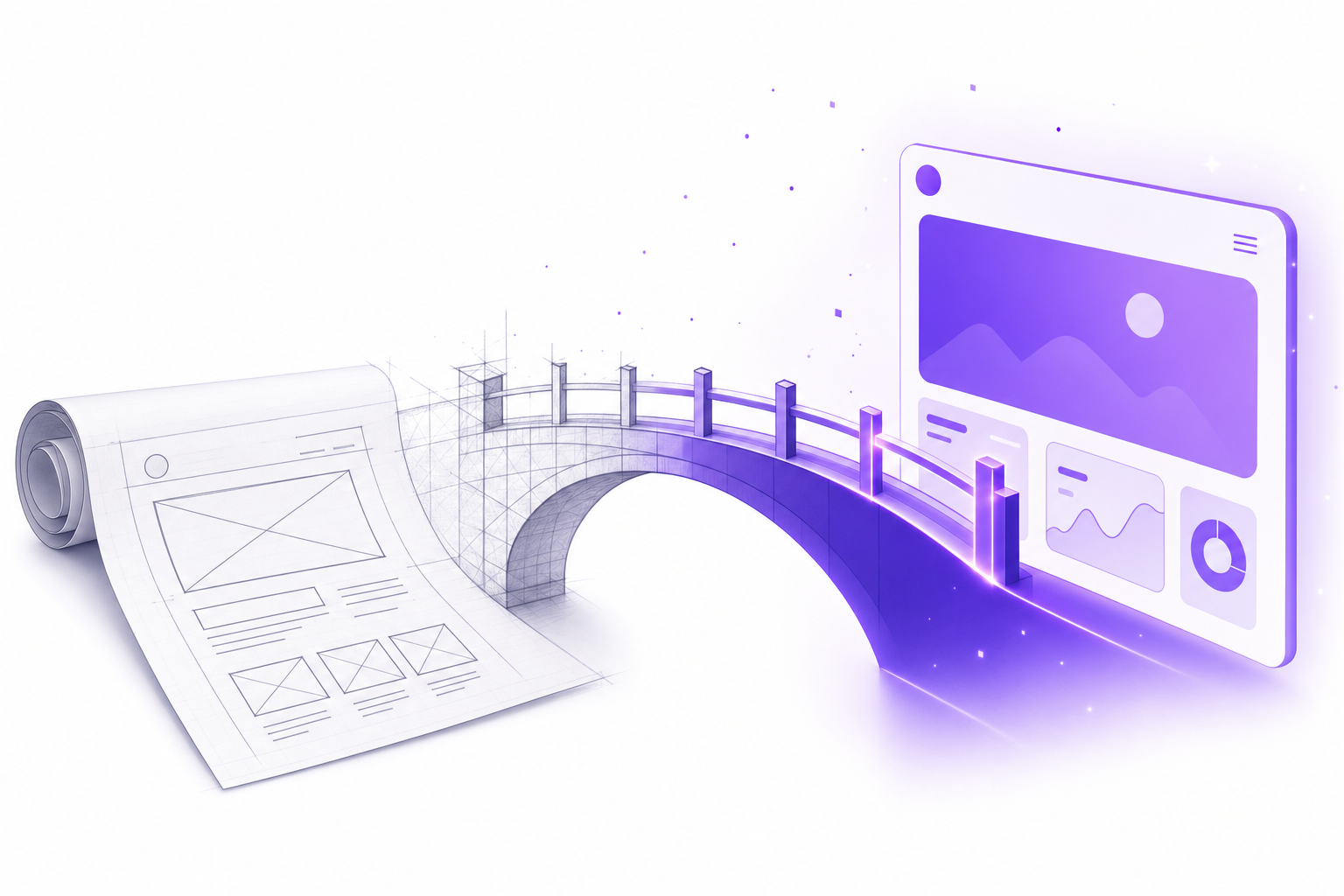
Product cycles have compressed by 10x. Features that used to take months now take weeks, sometimes days. Everyone in this industry has felt it. But here is what nobody talks about: the workflow we use to hand off work from PM to engineer was built for the old timeline. It was not built for this one. And it is breaking, quietly, in almost every team I talk to.
Here is the problem. You write a PRD. You write detailed user stories. Maybe you sketch wireframes or drop a Figma link in the ticket. You think you have been clear. Then two weeks later the feature ships and it is not quite what you meant. The dropdown works differently. The empty state is missing. The flow has an extra click you did not intend. Nobody did anything wrong. This is just what happens when you translate an idea into words, hand those words to another human, and wait for them to reconstruct your idea from your description of it. Something always gets lost. And then you spend the next three days in Slack going back and forth on "but the spec said X," which was supposed to be the fast part of a fast cycle. It is not fast. It never was. We just used to have enough slack in the timeline to absorb it.
So here is what I actually do now, and it has completely changed how I ship features.
The Prototype as Spec
I build the frontend myself. Not with a designer, not with a developer, just me and an AI tool like Replit or Lovable. In an afternoon, sometimes less, I can put together a functional prototype that looks and behaves like the real product. Every screen, every state, every dropdown, every modal, every edge case I care about. It is not production code and it was never meant to be. Nobody is going to ship what I built. But it works, you can click through it, and it looks like the real thing.
While I am doing that, I write a different kind of PRD. Not a spec for the UI, because the UI is sitting right there and anyone can look at it. I write a spec for the engine. Data models, API contracts, business logic, permission rules. The stuff that does not show up when you click a button but absolutely has to be right underneath it. That is the part that still needs careful thinking and clear documentation, because no amount of clicking through a prototype tells a developer how your data should be structured or what happens when two users hit the same edge case at the same time.
This full-stack approach is how I work as a hands-on IC product manager. I do not look at only one layer. I look at strategy, UX, architecture, data, and execution together. Strategy tells me what data matters. Data tells me what UX to build. UX tells me what architecture supports it. Execution ties it all together. Each layer informs the next, and skipping any one of them creates a gap that shows up later.
How the Handoff Changes
Then I hand both things to the developers together. Here is what it should look like, and here is how the engine underneath it should work. Their job is not to interpret my intentions from a document. Their job is to take the prototype, knowing that everything you build will get rewritten or thrown away, so refactor to make it fast, scalable, and secure following best practices, and wire up the real backend behind it based on the architecture doc.
This works because it removes ambiguity at the exact point where ambiguity used to live. "What did you mean by this dropdown" is not a question anymore, because the dropdown is right there, working, in front of both of us. Nobody has to guess what I meant by "intuitive filtering" because I did not write that phrase anywhere. I built the filter and you can use it. When a developer has a question about behavior, they do not open a ticket, they open the prototype and try it themselves. And when I need to change something, I change the prototype directly and push it. They see the diff in GitHub or Lovable within minutes. Not days. Minutes. The feedback loop that used to run through meetings and comment threads now runs through commits.
Who This Is For
I want to be direct about who this is for, because it is not for everyone. This works for PMs who understand code well enough to work through AI-assisted tools like Lovable or Replit and guide them effectively. You do not write every line yourself, but you need to understand architecture, trade-offs, and best practices to direct the tool. The PM guides the AI architecturally, making decisions about data flow and structure while the tool handles the implementation. This is different from being a coder. It is being a product person who can use AI as a force multiplier. It works for founders who want to move fast without hiring three more people just to keep specs synchronized. It works for solo builders transitioning from doing everything themselves to handing pieces off to a real team, because it lets you keep the part you are good at (product thinking, UX instinct) while offloading production-grade engineering.
There is a catch, and I will not pretend there is not one. You need actual UX skills, not frontend skills. You need to be completely comfortable knowing that everything you build will get rewritten or thrown away, and you cannot get precious about your own output, because the prototype was never the point. It was the communication tool, not the deliverable. And your developers need to be the kind of people who are fine receiving "here is what it should look like, go build the real version" instead of a forty page document that pretends to answer every question in advance. Some engineers want that documentation security blanket. This workflow asks them to trust a working prototype instead, and that is a real cultural shift on some teams.
The Ambiguity Gap Disappears
But if your team can make that shift, the payoff is real. The ambiguity gap that used to eat half your compressed cycle time just disappears, because there is nothing left to be ambiguous about.
Being an IC product manager has always been about staying close to the details. With AI, that role just became something bigger. The super IC PM now owns strategy, data, UX, architecture, and execution all at once. You are not just writing specs. You are shaping the full product across every layer, and the tools let you move at a pace that was impossible two years ago.
So next time you sit down to write a twenty page PRD, try building a twenty screen prototype instead. It will take you less time than the document would have. Your developers will have fewer questions, not more. And your engineers will thank you, because for once, they will know exactly what they are building before they write a single line of it.